I consider my paintings to be teaching tools, so further steps for me in the process occur as I actually teach the stories by using slides of the scenes along with the paintings as a whole. I continue to discover more connections between the scenes- and even between one painting and another- and draw what I consider to be convincing theological conclusions.
Mark 1
As an "untrained
artist" (your words), do you ever feel intimidated by other artists?
I am in awe of the skills of
trained artists, but I donʼt feel intimidated by them. I see my calling as
complementary, not competitive, to theirs. I have, however, encountered sharp
and potentially discouraging words from critics who donʼt understand the
purpose and inspiration of my art. Recently a post on the Transpositions blog raised the question of what constitutes excellence
in art. Who decides? Will the gatekeepers let new creatures into the fold? Not
being a person with a high level of artistic skill forces me to be humble--a
good position for Christians anyway.
Aside from Scripture, who or
what inspires you?
Iʼm in love with the variety
and splendor of nature. I see creation as Godʼs art on the primary level. A
secondary level is human art--the surprising ways we continue to participate in
Godʼs revelation as, to use JRR Tolkienʼs word, sub-creators.
Who are your favorite
artists and why?
The first piece of art that
captured my imagination as a child was a “cartoon” by Saul Steinberg in The New
Yorker magazine. He combines artistic elements with words and concepts to reveal
deeper and more complex meaning. I see this marriage of visual with
intellectual as akin to Chinese ideograms. Iʼve become an avid collector of his
works and have all his New Yorker covers. I love Marc Chagall and his playful
use of color. I also relate to his narrative content. Iʼve visited the stunning
Chagall museum in Nice twice and adore his biblical paintings. David Hockney is
one of my favorites too. He gives me permission to adjust perspective to meet
the needs of the the story. I like artists who arenʼt compelled to comply with
traditional rules.
I heard Dr. Rex Jung in an interview with Krista Tippett refer to creativity as something
both novel and useful, but the usefulness is not always recognized within the
social context. This takes me back to the question of the gatekeepers and who
decides what art is valuable.
How would you describe your
style?
Primitive, child-like, bold,
yet theologically sophisticated. I combine artistic inhibition with careful
study. The “keys” that accompany my paintings enable viewers to follow the
stories and identify the verses being portrayed.
I like the Revelation DVD
you produced. Any plans for similar projects?
Thank you. That video was
another step into humility. I recommend that everyone has the experience of
seeing themselves on the big screen. It doesnʼt take long until you have to get
over the reality of yourself! Painting your gut with a vision way beyond your
own capabilities. I felt called to make the visual content of that most
difficult and mysterious book available to the population at large. I think itʼs
crucial for us to know how the biblical story ends so we have courage to
persevere through the dark valleys. One of our dear friends, Don Hart of Move
Communications, caught the vision with me and made the video happen. We filmed it before the birth
of YouTube when production
costs were high. I would love to do something similar with my other
paintings--perhaps in small segments--but I would need help. The studying and
painting are enough for me. I deeply desire to find ways to transfer the work
Iʼve done into the hands of other Bible teachers. I have made sturdy, full-size
reproductions on fabric that can easily be tacked up on walls or hung between
trees. I have often been told that my style is cross-cultural. I would love to
have these biblical pictures used to pique curiosity and complement teaching. I
also have a vision of using the images of individual scenes on a smart phone
app so visual learners could watch and listen to the text at the same time. I
have the content, but I need help with the platform. Iʼd like to interject an
opinion: There are many mission-minded people who pull specific stories from
Scripture to weave an overall teaching of the gospel. While there is certainly
great value in this, I think it is also true that if we go thoroughly into the
whole content of one book of the Bible, we can gain the gospel message from a
different angle. There is a depth that comes from examining all the stories of
the early disciples, or all the events in one gospel. I was surprised when I
painted Acts to notice the cross and resurrection are in every sermon.
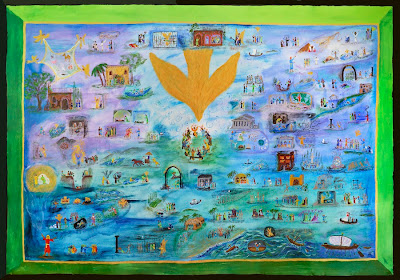
Book of Acts
Your work has been seen in
churches and various teaching venues. Do you have a particular
'audience' in mind when you approach a piece?
My first audience is me. I
mentioned that people who have travelled and worked in other cultures say my
work is cross-cultural. That pleases me very much, but it was not a conscious
intention but the result of my limited ability. I donʼt paint faces because I
donʼt have that skill. Children quickly warm up to my work, but that is not an
intention either. I think my style is child-like because at this point in life,
Iʼm interested in being in touch with my own uninhibited inner child.
A second prong of my passion
is to encourage others to adapt my “visual lectio divina” process to their own
study of Scripture. I have a how-to book in the works to lead people through
visual study of key passages of spiritual growth.
What comments have you
received from 'un-churched' viewers who may not know Scripture?
Two years ago I showed all
four of my large paintings at ArtPrize in Grand Rapids. All sorts of people came to the
three-week city-wide event. I found that having whole books on one canvas enabled
people to enter the gospel story from many different directions. To a Catholic
unfamiliar with Scripture I could point to the Last Supper and take the story
on from there. With a group of Muslims I got into a discussion of the Crucifixion
in Mark and whether Jesus really died. Then we looked at Jesusʼ return in
Revelation and Johnʼs depiction of heaven. It quickly became evident where we agreed
and disagreed. (Iʼd love to show the Life of Abraham to Muslims. Iʼm fascinated
with Godʼs care of Hagar and Ishmael.)
I also had a wonderful
“discussion” with a man from Puerto Rico who did not speak any English, but who
knew the Bible intimately. He helped me realize that my paintings taken as a
whole represent the Trinity: God the Father on the throne in Revelation, Jesus
as a man walking among people in Galilee and Jerusalem, and the Holy Spirit
manifested at Pentecost and throughout Acts.
What advice do you give
young artists?
Overcome your inhibitions.
Paint first to please
yourself.
Follow your passion.
Silence your inner critic.
Embrace your mistakes.
Be bold.
Ask God for help.
Have fun!
You can view Debbie's work and read more about her on her website-


